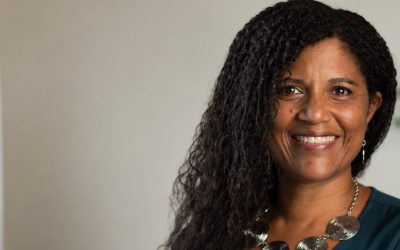
From the burn unit to the protest line, from recovery to cannabis nursing, Sue DeGregorio-Rosen has spent more than four decades caring for people, confronting injustice, and asking where her experience could do the most good.
“Where do I belong?”
It is a question Sue DeGregorio-Rosen has carried across decades, cities, movements, and roles. She asked it as a young mother trying to build a safe future for her children. She asked it in burn units and trauma centers, at union meetings and protests, and as the cannabis movement began taking shape around her.
“I do really good stuff with really sick people,” she remembers thinking. “So where do I belong?”
In her Conversations that Connect interview, Sue’s answer emerges not as a single destination, but as the thread connecting an extraordinary life: she belongs wherever courage and care are needed together.
Nursing as a Way Forward
Sue grew up in Paterson, New Jersey, in what she describes as a rough neighborhood. She was the oldest child in a large, loud Italian family—small in stature, outspoken by nature, and accustomed to standing her ground.
By 18, she had two young sons and was trying to leave an abusive marriage. She understood that building a different life would require a plan, an income, and an education. A supportive caseworker connected her with New Jersey’s Educational Opportunity Fund program, and Sue arrived with a clear ambition: she wanted to become a pediatric surgeon.
The counselor encouraged her to begin with nursing—to enter healthcare, discover what was possible, and find where she truly wanted to be.
That suggestion changed the direction of her life.
Sue attended nursing school while raising her children, sometimes bringing them with her as she studied and tutored other students between classes. She began working at Planned Parenthood and quickly discovered something important about herself: she did not simply enjoy medicine. She loved people.
Nursing was no longer a practical alternative to her original dream. It was becoming her calling.
Caring for the Whole Person
After graduation, Sue entered the burn intensive care unit at Saint Barnabas, then the burn center of New Jersey. She remained there for eight years, caring for adults and children with devastating injuries.
The nurses called themselves “the special breed.” Their patients needed sophisticated clinical care, but they also needed extraordinary tenderness. Severe burns could affect nearly every body system and leave patients disoriented, frightened, or experiencing burn psychosis.
“It was a lot of love and care and tenderness,” Sue says.
That environment also introduced her to forms of holistic care that were remarkably progressive for the 1970s. In 1978, the unit brought in a Reiki master to teach the staff. They explored hypnosis, environmental changes, and even ketamine therapy in their efforts to ease suffering. Clouds and bright stars were painted on the ceiling above patients undergoing painful treatments.
Not every intervention worked. What stayed with Sue was the willingness to keep asking what might help.
Her career continued through burn care, emergency and trauma nursing, and hospital administration across New Jersey and New York. She helped build high-acuity programs, worked alongside teams she still describes as “golden,” and developed confidence in the knowledge she had earned at the bedside.
That legacy has now crossed generations: two of Sue’s grandsons work at Hackensack and are studying to become nurses.
The Fire to Speak Up
Sue’s nursing and activism were never separate identities. Both came from the same instinct: pay attention, protect people, and speak when something is wrong.
She traces some of that fire to being the oldest child and some to the place and era in which she came of age. She joined NORML in its earliest years and participated in Students for a Democratic Society, marching for civil rights and against the Vietnam War. A newspaper photograph even captured the young activist climbing through a window at Columbia University.
Over time, the expression of her activism changed. The young woman climbing through windows became a union organizer, labor advocate, strategist, mentor, and educator.
“I like to be the person in the background kind of directing the movie,” she says. “If I can sit in that seat, I’m good. And I will give you the best of me.”
Her work with the New York State Nurses Association placed her on Wall Street. On September 11, 2001, Sue was attending a meeting in Albany rather than working in her downtown office. She returned six days later after workers were told the area was safe—an assurance she now knows was untrue.
The experience left a lasting mark. Yet New York City also kept her close to emerging movements and new ideas. She listened, observed, participated in Occupy Wall Street, and continued asking how her experience might serve something larger.
Recognizing Cannabis as Medicine
Sue’s understanding of cannabis did not begin in a classroom or professional specialty. It began through lived experience.
As a teenager, she learned that cannabis could relieve menstrual pain. When she later went into labor frightened and alone, her Italian grandmother gave her a honey-covered preparation dipped in what Sue now recognizes as cannabis oil. It did not stop the contractions, but it helped calm and ease her.
“That’s where I saw that this stuff is medicine,” she says.
As her nursing career developed, Sue began thinking about patients who might benefit.
“We could use this,” she remembers thinking. “Why aren’t we using this?”
The question stayed with her even when colleagues dismissed it. She describes herself as thinking like a cannabis nurse from the moment she became a nurse—she simply did not yet know where to place that identity.
Sue continued listening and learning. She followed the medical cannabis movement, attended Patients Out of Time in 2010, traveled across 38 states as a union organizer, and witnessed the fractures in American healthcare firsthand. Everywhere she went, she assessed the landscape the way a nurse and organizer would:
“What do I have to offer this community, and how do we bring this movement together?”
Finding the Place Where It All Belonged
Sue was 16 when she attended Woodstock. Beyond the music, what stayed with her was the way people helped one another.
“Everybody loved each other,” she recalls. “If somebody didn’t have water, or somebody didn’t have food, we shared.”
That longing for community followed her for years. She knew how to care for critically ill patients. She knew how to organize, protest, teach, and challenge authority. She understood cannabis personally, clinically, and politically. What she had not yet found was a place where all those parts of her could exist together.
Then she began meeting the nurses who would become Cannabis Nurses Network.
“I started to really feel that maybe this is where I do belong,” she says. “Maybe this is what I really need to do.”
For Sue, cannabis nursing offered more than a professional title. It created a bridge between her clinical expertise, holistic values, activist spirit, and belief in community. She became part of CNN’s founding generation and helped shape a network built to educate nurses, advocate for patients, and recognize cannabis as medicine.
Recovery Without Shame
Sue’s story also includes addiction and recovery—experiences she discusses with unusual candor and without self-punishment.
“Addiction is a disease, and it’s nothing to be ashamed of,” she says. “And there is no blame.”
Sue connects the escalation of her substance use to a period of accumulated pain, including the aftermath of 9/11.
“2001 punched a big hole in my stomach,” she says.
What began around professional events and social gatherings escalated before she fully recognized what was happening.
Looking back, she understands that she was trying to numb pain. She also understands how difficult it can be for healthcare professionals to recognize their own vulnerability—and how stigma can keep people silent.
Her philosophy of recovery is a gentle one because, as she explains, addiction carries a stigma much like cannabis does. Shame does not create healing. Compassion, honesty, education, and accountability can.
Sue does not present recovery as a detour from the rest of her life. It is part of the wisdom she now offers others: lived experience can become a source of understanding when we are willing to tell the truth about it.
Becoming the Models Others Need
Sue remains fiercely protective of nursing. A recent hospitalization placed her on the patient side of care and heightened her concern about assessment, critical thinking, and the fundamentals of bedside practice.
But her message to newer nurses is not that they cannot succeed. It is that they deserve strong preparation and experienced professionals willing to model excellent care.
“I want to see them be successful,” she says. “I want to see them succeed, and I want to see them be really good nurses.”
Perhaps, she suggests, those who have spent decades at the bedside can become the models the next generation needs.
That responsibility extends to cannabis nursing. Sue wants cannabis recognized as both medicine and sacred medicine. She wants patients to feel safe, receive trustworthy information, and have meaningful access to knowledgeable nurses.
“The nurse needs to give them at least a good answer,” she says. “At least something to walk away with and feel safe.”
Her focus is increasingly on those coming behind her—her grandchildren, younger nurses, developing advocates, and communities navigating a future crowded with information but not always grounded in wisdom.
“I Am a Good Nurse”
When asked what makes her most proud, Sue does not hesitate.
“My career,” she says. “I was a damn good nurse. I am a good nurse.”
It is not simply pride in the jobs she held or the clinical skills she mastered. It is pride in a lifetime of showing up—in burn units and emergency departments, on protest lines and inside organizing meetings, for patients, colleagues, families, and communities too often left without protection.
Sue DeGregorio-Rosen spent years asking where she belonged. Her story suggests that belonging was never about finding one narrow role. It was about finding the community spacious enough to hold everything she had become: nurse, organizer, activist, cannabis advocate, mentor, mother, grandmother, survivor, and truth-teller.
And for those coming behind her, she leaves both a challenge and an invitation: pay attention, care deeply, tell the truth, and help create the places where others can belong too.
Watch the Conversation
Watch the full Conversations that Connect episode, Where I Belong: Sue DeGregorio-Rosen’s Lifetime of Nursing, Activism, and Finding Her Place, and hear Sue tell these stories in her own unmistakable voice.
Conversations that Connect is a Cannabis Nurses Network series devoted to stories, wisdom, and community.